Five Things We Learned From Super Bowl XLV
ESPN.com
 Al Bello/Getty ImagesGreen Bay's T.J. Lang (70) doused head coach Mike McCarthy to celebrate the Packers' 31-25 victory over the Pittsburgh Steelers in Super Bowl XLV at Cowboys Stadium.
ARLINGTON, Texas -- Super Bowl XLV was a game of attrition.
The Green Bay Packers lost wide receiver Donald Driver (high-ankle sprain) and cornerback Charles Woodson (broken collarbone) in the first half. Sam Shields, the Packers' talented third cornerback, injured a shoulder and missed more than a quarter of the game. The Pittsburgh Steelers lost wide receiver Emmanuel Sanders (foot) and didn't have Pro Bowl center Maurkice Pouncey (high ankle) or defensive end Aaron Smith (triceps) in uniform.But the Packers proved to be the more resilient team Sunday, holding off a Steelers comeback and winning Super Bowl XLV 31-25 in Cowboys Stadium. While Driver was trying to tape up his throbbing ankle at halftime in hopes of returning to the field, he heard his teammates shout in the locker room. Woodson, who knew his night was over because of the broken collarbone, had offered inspiration with a short speech that he finished by saying "Just win." "Everyone was saying on the sidelines, 'We've been through this before, it's nothing new,'" Shields said about losing three key Packers to injury. "Everyone just relaxed on the sideline. The defense was up, and that's what defense does: It wins games." The Packers had 15 players on the injured reserve list, including six starters, yet they got hot at the end and returned the Lombardi trophy to Titletown. Here's what we learned in Super Bowl XLV:
1. The long halftime helped the Packers more than it did the Steelers: While the Black Eyed Peas, Slash and Usher entertained the crowd on the field, Packers defensive coordinator Dom Capers and his staff had to make more adjustments to his defense than at any time this year. Woodson and Shields, two of his top three cornerbacks, were injured, forcing Capers to junk his plan to play a lot of man coverage. That was the scheme they used in the first half. Normal halftimes are 12 minutes long. Super Bowl halftimes last 28 minutes.
2. Like the New England Patriots, the Packers are the ultimate team: The Packers may have a rock-star quarterback in Rodgers, but it's their overall depth and unselfishness that enabled them to win their first Super Bowl. Driver suffered a high-ankle sprain in the first half, and Ike Taylor, the Steelers' best coverage cornerback, was locked on Greg Jennings, the Packers' best receiver. The Packers still stuck to their plan of using spread formations (three- and four-receiver sets) and watched Rodgers distribute the football. Packers head coach Mike McCarthy knew that Jordy Nelson -- the team's fourth-best receiver, who moved into the No. 3 hole with Driver out -- could beat Steelers cornerback Bryant McFadden. McFadden plays off coverage and, as Jennings says, doesn't have a great first step in getting back to the receiver. Nelson was targeted 15 times and caught nine passes for 140 yards and a touchdown. Sure, he dropped three passes, but he made enough plays to move the offense. It eventually forced the Steelers to use a bit too much Cover 2 defense down the stretch, when Jennings could make big plays. Here is the ultimate team stat for the Packers: They had 11 different players score touchdowns during the playoffs, topping the standard of 10 that had been set by six other teams.
3. If these teams meet 10 times, expect the same type of game in all 10 games: Super Bowl XLV was almost a repeat of their 2009 regular-season game in Pittsburgh. In that high-scoring game, the Steelers trailed 36-30 with 2 minutes, 6 seconds remaining and they had the ball on their 14. They rallied to beat the Packers 37-36.
In Super Bowl XLV, the Steelers trailed 31-25 and got the ball at their 13 with 1:59 left. Even though both teams have top-five defenses, they know each others' schemes and know how to beat them. Capers of the Packers and counterpart Dick LeBeau of the Steelers put together the 900-play playbook of the Steelers defense in 1992. The Packers started learning it in 2009 when Capers became the team's defensive coordinator. Capers likes to use a little more man-to-man than LeBeau.
If Roethlisberger gets the right matchups, he can come up with big drives. Likewise, Rodgers isn't intimidated by the Steelers' "fire zone" blitzes because he sees them every day in practice. Because of that, Steelers-Packers games should always be high-scoring and exciting as long as Rodgers and Roethlisberger are out there. It's one of the best matchups in the league.
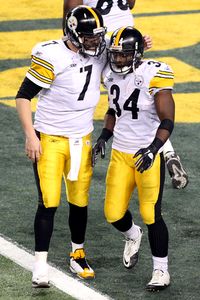
4. Roethlisberger will bounce back: Even though his two-interception game in Super Bowl XLV meant Roethlisberger didn't have great games in two of his three Super Bowls, he still showed how great he was in this game. Although his interceptions resulted in 14 points for the Packers and Rashard Mendenhall 's fumble handed the Packers another touchdown drive, Roethlisberger was able to rally the team from an 18-point deficit to get within three points.
He had several opportunities to be one drive away from taking a lead. He hurt his knee early in the game. He's been playing with broken bones in a foot, a broken nose and several other injuries. His teammates believe in him. "He's a warrior," wide receiver Hines Ward said. "He stayed in there. I think someone went at his knees, twisted his knee. His ankle was already bum, but he's always going to be a competitor to the end. That's why going into that two-minute drive I just knew we had a chance." Trailing by six points with 1:59 left, Roethlisberger reminded his offense of the faith he had in them to try to get the job done. The comeback stalled with three incompletions.
5. Thanks to Rodgers, the Packers are in for some kind of a ride: The NFC has produced nine different Super Bowl teams in the past nine years. I'm not saying the Packers will repeat next year, but this is the one team that could reach two or three Super Bowls in a five- to seven-year stretch.
Rodgers joined Kurt Warner as the only quarterback to throw for more than 1,000 yards and nine touchdown passes in the playoffs. They have a young core group that includes Jennings, Jermichael Finley, B.J. Raji, Tramon Williams, Clay Matthews, Ryan Grant, Cullen Jenkins, Nick Collins and so many others. Rodgers' 31-yard pass to Jennings on a third-and-10 from the Packers' 25 with 5:59 remaining illustrated how great he is in clutch situations. The Packers were holding on to a three-point lead at the time. An incompletion would have caused a punt and given the Steelers great field position. Jennings beat Taylor, the Steelers cornerback, at the line of scrimmage against press coverage. Rodgers caught the Steelers in a two-deep zone and he knew he could get a timing route to Jennings in the seam in front of Troy Polamalu. The Packers ended up getting another field goal and the win.
John Clayton's game balls

• Offense: In his first Super Bowl, Packers QB Aaron Rodgers was the MVP. He completed 24 of 39 passes for 304 yards and three touchdowns. His quarterback rating was 111.5. Had his receivers not dropped four or five passes, he might have had one of the best quarterback ratings in Super Bowl history.

• Defense: With 3:20 left in the first quarter, Packers Pro Bowl safety Nick Collins watched the coverage develop in front of him and read the eyes of Steelers quarterback Ben Roethlisberger. Collins picked off Roethlisberger's pass and returned it 37 yards for a touchdown. With Charles Woodson out for most of the game with a broken collarbone, Collins had to make sure every other defender was set in the right positions. He had four tackles, a pass defense and an interception.

• Special teams: In a game that didn't feature many special-teams stars, Pittsburgh's Antonio Brown had the best game. He had four kickoff returns for 88 yards. His numbers would have been better had it not been for penalties.

Comments
You must be signed in to post a comment