
At every World Cup, there's always a collection of players who emerge as breakout stars. In 2010, players such as Alexis Sánchez, Mesut Özil and Luis Suárez burst onto the scene. James Rodríguez in 2014 became a household name by leading Colombia to their first quarterfinals run at a World Cup. The past two tournaments saw Benjamin Pavard (France), Hirving Lozano (Mexico), Enzo Fernández (Argentina), Azzedine Ounahi (Morocco) and others raise their profiles.
Emerging as a star during the World Cup doesn't automatically mean future greatness is a given. Lozano and Ounahi are examples of players who had impressive tournament showings and went on to have fine careers but didn't capture the imagination like in 2018 and 2022, respectively. The same could be said with Rodríguez, who had an impressive debut season with Real Madrid in 2014-15 only for the rest of his career to be plagued by injuries and inconsistent performances. Of course, you also have someone such as Luis Suárez, who later became one of the best players of the 2010s at Liverpool and then Barcelona.
Perhaps the 2026 World Cup hasn't quite had the awe-inspiring performances from emerging stars like in previous tournaments. Instead, the big theme has been several established superstars -- Lionel Messi, Kylian Mbappé, Erling Haaland -- playing at very high levels simultaneously. Still, we've seen a few talents who have raised the eyebrows of some with what they've produced.
- Borden: Instead of being USMNT's biggest star, Pulisic was a disappointment
- O'Hanlon: Grades for every eliminated World Cup team
- 2026 World Cup: All fixtures, results and feature coverage
Yan Diomande, LW, RB Leipzig / Ivory Coast
You could argue that he doesn't quite fit the spirit of this exercise. After all, his age-18 season in 2025-26 saw him produce 20 goals plus assists in the Bundesliga for an RB Leipzig side that finished third. Even in a league that allows attacking talents to shine, teenagers don't normally produce such a sparkling campaign, and his form meant he deservedly came into the World Cup with a lot of intrigue surrounding his game.
However, for those who saw Diomandé for the first time, he showed his potential to become a star attacker. The big selling point is that he might already be one of the most electric dribblers in Europe. He has incredible explosiveness, and even at only 19 years old, can absorb contact at a credible level. Combine that with impressive two-footedness, and you get a tough matchup for any defender.
Only France star Kylian Mbappé has created more chances from carries (nine) in the World Cup than Diomandé's eight, according to Opta Analyst, and the French star has played two more matches (and counting).
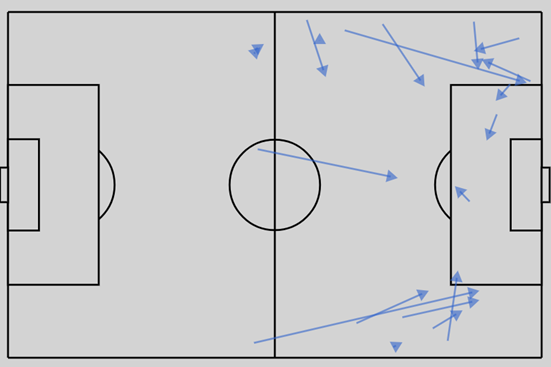
The best example of what Diomandé can do happened in Ivory Coast's opening game of the group stage against Ecuador in Philadelphia. We saw the quick feet to make stuff happen, including an eyebrow raising two-tap pass to find Elye Wahi for a good chance in the first half. When situated on the right flank, he gave Arsenal defender Piero Hincapié a tough time with the constant changes of pace. Moving to the left flank later in the second half saw him become more aggressive with his shooting.
The all-action map from Futi shows how much trouble Diomandé gave Ecuador, a side that only conceded five goals in 18 South American WC qualifying matches.
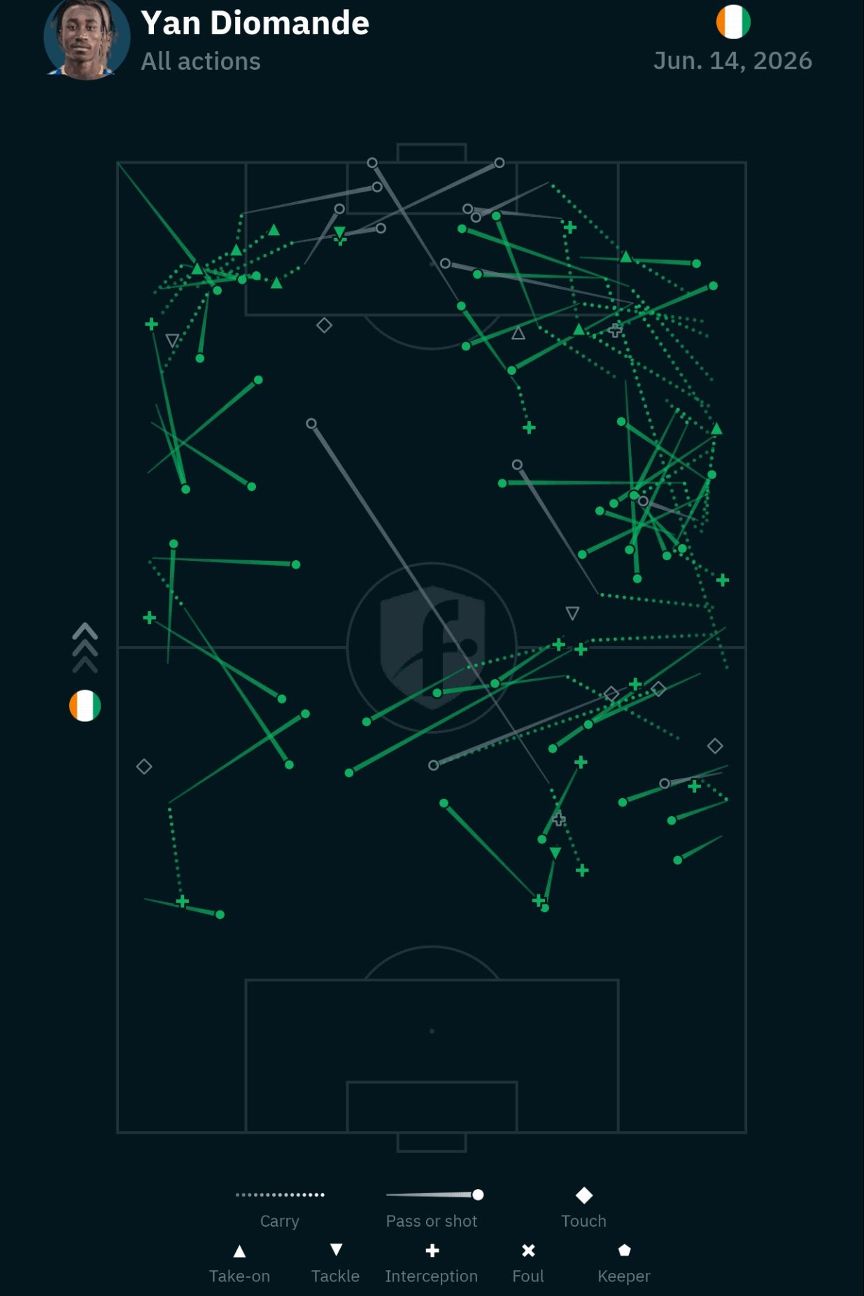
Diomandé's performances in the following matches before Ivory Coast's elimination to Norway in the round of 32 didn't quite match the lofty standards of his debut, though he still provided some superstar moments. It's no surprise that a club such as Paris Saint-Germain is trying to acquire him this summer. The way his development is progressing, it won't be a surprise if by 2030, Diomandé is universally seen as one of the best players in the world.
Alex Freeman, RB/CB, Villarreal / United States
Through their first four matches in the 2026 World Cup, the United States looked good without many caveats. There were convincing victories over Paraguay and Australia in the group stage before Mauricio Pochettino's team beat Bosnia-Herzegovina 2-0 in the round of 32. Even accounting for the quality of opponents, you could argue it was the most convincing they looked in a single run of games.
What made the U.S. look better than expected was how much they played to their strengths. Sergiño Dest and Antonee Robinson would take high positions as wing backs to pose threats. There was an emphasis on verticality with runs through midfield from Weston McKennie and Malik Tillman. Both of these things helped them break down mid-blocks successfully.
To make this work, the U.S. needed at least one versatile defender who could help in different areas, and that turned out to be Freeman. He would often play as a third central defender on the right, but he had the flexibility to move forward when the U.S. had the ball in the final third.
A common pass you would see throughout their World Cup run was Freeman spotting McKennie making a run along the right side into space, creating a secondary chance or even an assist. According to Futi, Freeman ranked first in progressive passes with 28, somewhat of a pleasant surprise given his expected role.
Freeman is also the kind of ground covering defender who can help clean up mistakes in different areas of the pitch. This included covering the space out wide and defending in one-on-ones when needed. There were also situations where he had to make critical interventions to eliminate clear-cut opportunities.
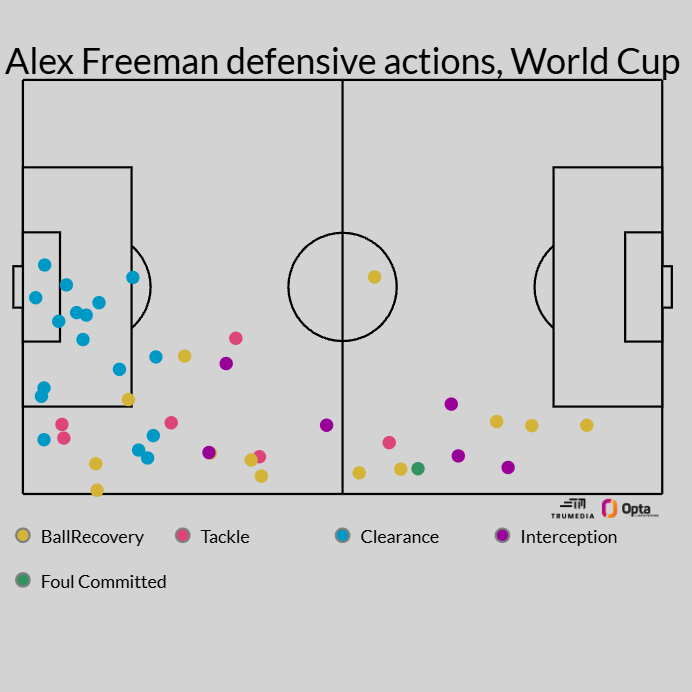
Of course, the good performances ended up not lasting for the U.S., as they were a clear second best in a 4-1 defeat to Belgium. Such a loss (particularly since it was the weakest Belgium side in over a decade) has sparked discussion concerning the men's program, including the lack of stars to come through. If there was a player who could hold his head high despite the outcome, it was Freeman. The odds of him becoming one of the stars the U.S. need by 2030 are low, but at this World Cup he showed the faint outlines of a high-end all-around defender.
Johan Manzambi, CAM, Freiburg / Switzerland
Those who regularly watch the Bundesliga were already aware of Manzambi's rise with Freiburg. Although he broke through to the first team toward the tail end of 2024-25, this past season was when he truly announced himself to German football. Nine goals plus assists in over 2,000 minutes was a good return for a player who could ostensibly be labeled as a box-to-box midfielder. Besides that, his ability to eat tons of yardage through his progressive carries made him an intriguing prospect.
Compared to others in this list, Manzambi has been used more sparingly in the 2026 World Cup. He's started in only two of Switzerland's five matches, against Canada and Algeria in the round of 32, and while nursing an injury later in the tournament, there could have been some tactical concerns with Switzerland trying to maintain defensive stability under Murat Yakin. There can be a lack of concentration defending in his own third, along with not being totally in sync with teammates when it's time to press.
Still, there's an argument to be made he should've been a starter from the beginning. He's got three goals and two assists in four appearances, and while two goals came as a substitute vs. Bosnia-Herzegovina, he scored and assisted vs. Canada while providing an assist against Algeria. According to Futi, he's just inside the top 50 for total progressive carries in the tournament. His solo carry and assist versus Algeria early in the first half gave Switzerland an advantage, and they didn't look back.
There are other strengths to Manzambi's games outside of his prodigious ball-carrying. In particular, he's shown the capacity to play off of Breel Embolo whenever the Swiss striker has his back to the goal. Manzambi has also shown the ability to attack space from deeper areas if the opposition is giving too much attention to Embolo. The two combined for Switzerland's second goal in their 2-1 victory over Canada, with Embolo attracting two Canadian defenders and laying it off to Manzambi in the box.
Manzambi has shown some impressive peaks during the World Cup through his ability to progress play and burgeoning box-crashing. There are questions about his game, such as how much he can improve his progressive passing and whether he can make an impact defensively. However, the flashes of brilliance shown with Freiburg and in the World Cup are enough to believe he could become a top-notch midfielder in the not-too-distant future.
Gustavo Puerta, CM, Racing Santander / Colombia
Like the United States, Colombia looked quite good through the round of 32 and had a chance to solidify themselves as an under-the-radar contender in this World Cup. They conceded only one goal over the four matches and while scoring just five, they were creating a ton of shots (third in shots per match, according to Opta Analyst), and just enough of them were of very high quality (13th in non-penalty expected goals per match).
Colombia showed the ability to play in settled possession through fluid positional interchanges and create direct attacks after winning the ball with their sturdy mid-block. They used different shapes on the ball to break games open, including an aggressive 3-1-6 formation to break down stubborn low blocks (such as against Ghana in the round of 32). Despite the goal-scoring woes, the underlying results were in their favor. An example is in the 0-0 group stage draw to Portugal; they outshot them 24-13 and generally outplayed them.
To accomplish this, Colombia needed players who could help in different areas. Puerta showed his capacity to play multiple roles, whether it be trying to orchestrate between the lines or providing runs in behind as part of the frontline. According to stats collected by FIFA during the World Cup, he ranked second in offers inside team shape and fourth in offers in behind. Via the Futi app, only Juan Fernando Quintero generated more total expected assists. Puerta did several things at a solid or better level.
Puerta's versatility also showed itself out of possession, with his activity being a key part in maintaining their defensive solidity. No Colombian player applied more defensive pressures or direct defensive pressures than Puerta. This is not a surprise to those who watched him this past season for Racing de Santander, with the World Cup being a continuation of the growth shown in Spain. Arguably his best performance came against Ghana, where he ran the show and was arguably the best player of the match.
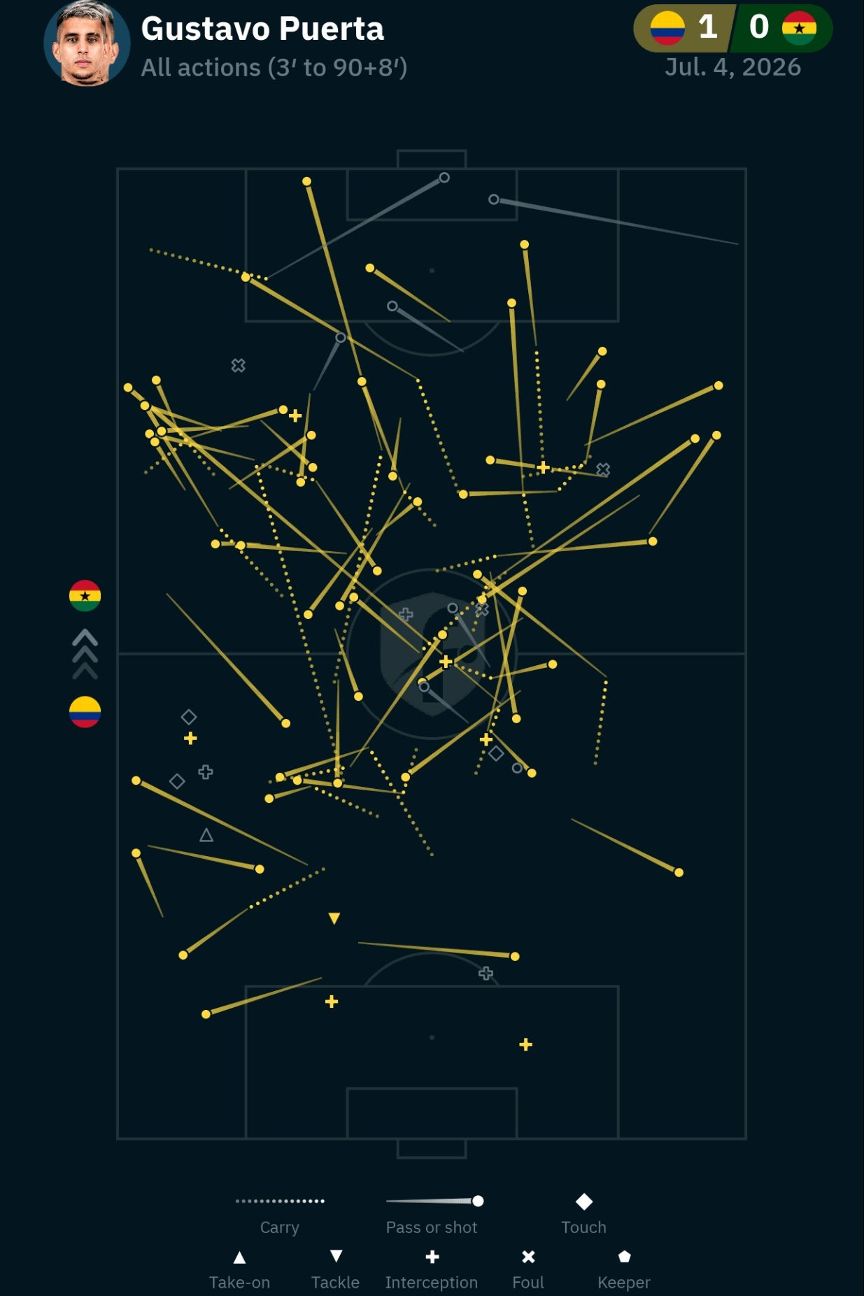
Unfortunately for Colombia, their promising run ended on penalties versus Switzerland. They could not find the crispness to break down the Swiss' stubborn 4-4-2 mid-block which offered little space between the lines.
Despite potentially being eliminated a round earlier than expected, Puerta's performances showed what he could provide to clubs for years to come as a midfielder who contributes in multiple phases of play.
Ismael Saibari, CF, Bayern Munich/Morocco
The past few years have been a resurgence for Morocco's men's national team. They were the first African nation to make it all the way to the semifinals of the World Cup in 2022. There's the contentious 2025 Africa Cup of Nations victory over Senegal (with its ultimate fate being in the hands of the Court of Arbitration for Sport). Even though Morocco couldn't quite match the heights of 2022, their quarterfinal exit to France this summer still represents a successful tournament run.
We've seen numerous Moroccan talents emerge since 2022 and one of the biggest is Ismael Saibari, who spent his youth career in Spain and Belgium before signing with PSV Eindhoven in 2020. After slowly breaking into the first team through 2024, the past two seasons saw him become one of the most productive players in the Dutch Eredivisie. He has ranked first (2024-25) and third (2025-26) in non-penalty goals and assists per 90 minutes among qualified players. While the league does skew very young, and PSV have been the dominant club in the division, those numbers shouldn't be taken lightly. (News during the tournament that he's joining Bayern Munich makes sense given his uptick in performance.)
Like other talents who play for Morocco, Saibari's ability to do different things on the ball makes him an additive attacker. He has above-average agility and balance, which combined with his decent strength, allows him to protect possession while accelerating away from opponents. Although the dribbling itself was not seen much at the World Cup, he still tried to attack open space when possible.
Having a ton of players who are most comfortable receiving to feet in front of the opposition meant Morocco needed someone to help stretch the opposition and keep them honest. This was particularly the case once Abde Ezzalzouli's injury ruled him out of the tournament during the lead up, as his strong season with Real Betis was partly fueled by off-ball movement. Saibari helped replace that before his injury in the round of 16 against Canada.
Via FIFA, he led Morocco in offers in behind. The gap between him and second-place Achraf Hakimi was nearly double (151 vs. 79). When his teammates got into dangerous areas around the penalty box, he more often than not relied on fading away to make himself available for cut-backs. Although Saibari took only 10 shots, the average quality was quite high (0.17 xG/shot), as shown by the shot map below.
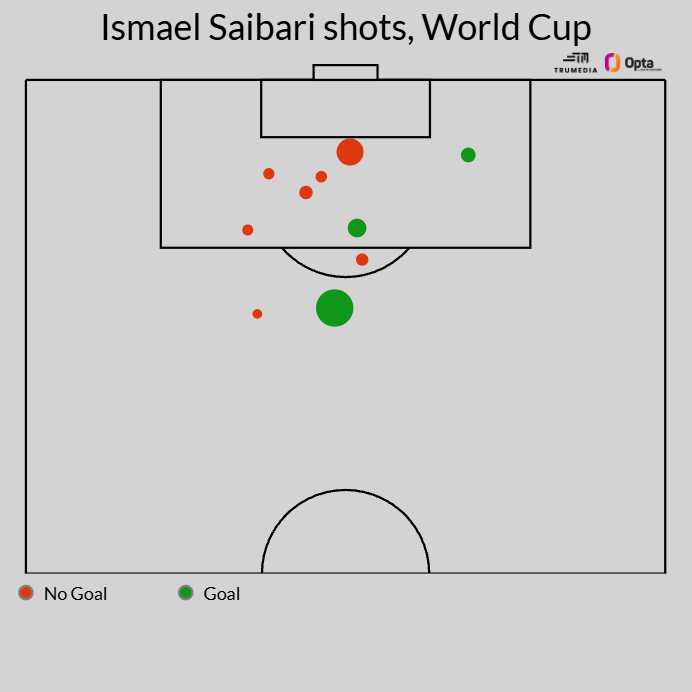
Saibari's absence in the quarterfinals versus France made a very tough task for Morocco even harder. Without any way to stretch France out of possession, Morocco were stifled and the European giants' superior talent eventually took them to a decisive 2-0 win. It'll be interesting to see how much of a role he'll have with Bayern Munich; if the multifaceted nature of Saibari's game travels to the Bundesliga, there should be future success for him going forward.
