

There is nothing like the crescendo of a raucous crowd in Brazil -- especially once those 31,000 fans know they have their opponent rattled. No team discussion or training-ground drill can replicate that kind of pressure.
The United States women's national team got smacked in the face with that animosity on Saturday in São Paulo in a 2-1 friendly loss to Brazil -- its first game in the country since the 2016 Olympics -- and its first-half struggles will leave an impression on the relatively inexperienced squad ahead of the 2027 World Cup. But a strong response in the second half also showed the Americans' mettle.
Sophia Wilson scored the opening goal for the U.S. less than two minutes into the match, and the rest of the half was almost entirely waves of Brazilian pressure that made it feel like the earth had fallen off its axis.
Taina Maranhão equalized after 11 minutes, when the U.S. was caught ball-watching on a throw-in. Three minutes later, the Americans got torched in transition by Brazil forward Bia Zaneratto, who ran about 6 yards mostly with the ball before eventually scoring. By then, the crowd was roaring.
"It was an amazing atmosphere and it's one that, as much as I can prepare my team for this, you don't really know until you experience it," U.S. coach Emma Hayes said afterward. "I am sure for many of my players this is the first time they've ever experienced an intensity from the crowd."
Nothing was surprising about the match conditions. Not the crowd booing the U.S. every time it had the ball in the opening minutes. Not the choppy match riddled with the type of "chaos" that Hayes said she both expected and wanted.
But still, this relatively young U.S. team -- only captain Lindsey Heaps remains from that 2016 Olympic roster -- played into Brazil's hands under the pressure. The Americans frequently opted for 50-50 flick-ons and lacked the awareness (and literal time) to put their collective foot on the ball and slow down the game.
Brazil often caught the U.S. in transition as Hayes' side turned the ball over in the attacking third. A young holding midfield pair of Claire Hutton and Lily Yohannes played in front of a back four that had never started a game as a unit, and goalkeeper Mandy McGlynn somewhat surprisingly started in the biggest game of her career to date. Brazil's pressure was relentless.
Wilson was the only bright spot for the U.S. in the first half as she tried to hold up the ball on an island at times. She nearly equalized in a one-on-one moment just before halftime, and she helped create the play that led to what could have been a red card for Maranhão when she dragged U.S. fullback Emily Fox down from behind just outside the box. Maranhão escaped with just a caution, and the U.S. escaped the half down only a goal.
Forward Michelle Cooper and defender Avery Patterson were subbed on at the start of the second half, and Patterson quickly asserted herself. She won a 50-50 ball from a Brazil goal kick that led to a long-range shot from Hutton in the 57th minute, which Brazil goalkeeper Lelê tipped off the bar. The U.S. then sustained its pressure on the ensuing corner kick, when Patterson's shot was deflected wide.
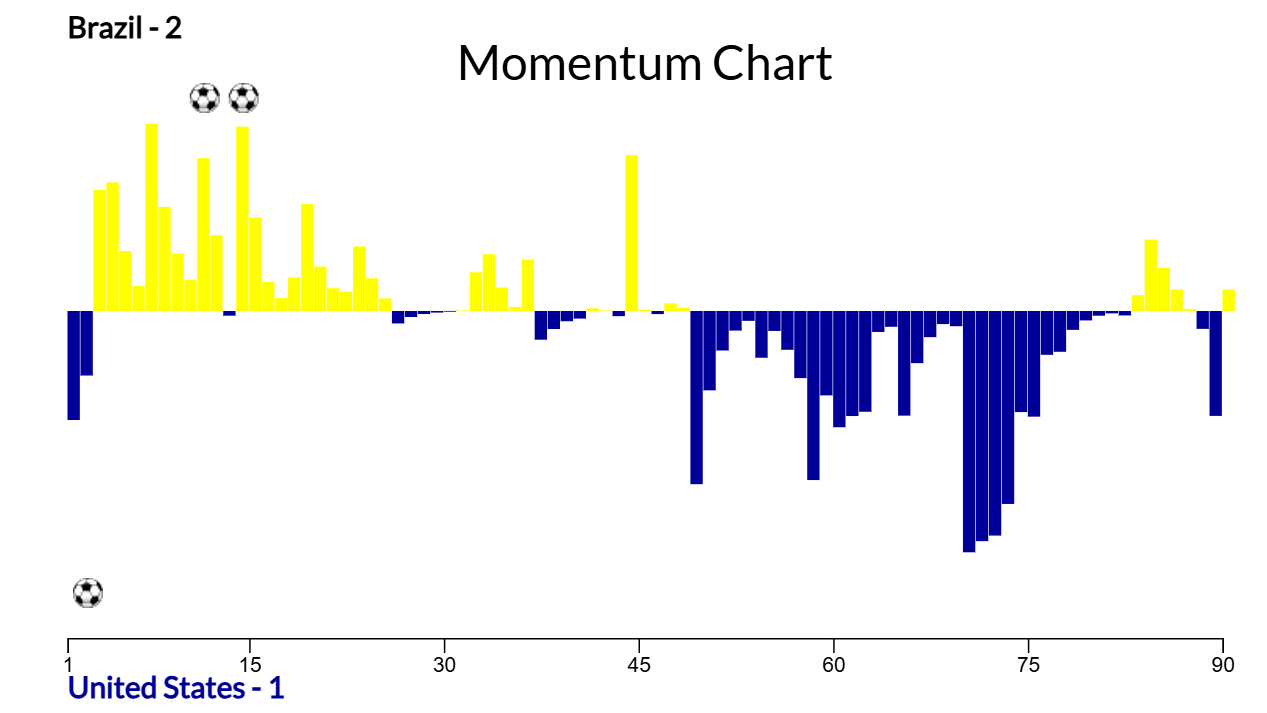
Momentum fully swung in favor of the U.S. after halftime. The energy was higher to help win duels, and the Americans got rid of the ball quicker after recognizing that the Brazilians would close them down.
"You have to compete first," Hayes said about the improved second half. "You have to compete physically, one-vs.-ones. You have to win your duels. I think our players don't necessarily get that exposure at the club level, so there's a lot to work on for these players because this is a different type of game. Sometimes it feels like a different sport. But the realities are you have to earn the right to play, and I think both Avery Patterson and Michelle Cooper brought a physicality to our team."
Still, even by matching their opponent's physicality, the U.S. lacked quality in the final third. Sometimes that was a shot off target and sometimes it was the final decision, like when Cooper got in behind the defense in the 75th minute but couldn't pick out a teammate.
If that, or Wilson's one-vs.-one from the first half, gets finished, then everyone would be talking about a draw, Hayes pointed out. Instead, the U.S. lost to Brazil for just the fifth time in 44 meetings (and for the third time in Brazil). Saturday was the U.S.'s second straight loss to Brazil after falling 2-1 in California last year.
Dominant winning ways of the past are "simply not possible in the modern game," Hayes said Saturday, pointing out how the margins are fine between the world's best teams. She was alluding to tactics about how to win. The same can be said about where the U.S. needs to win as Brazil prepares to host next year's World Cup.
"I am so happy for the experience, because if we want things to be easy, we stay home and we play in L.A. or somewhere else," Hayes said as she began to wag her finger in protest. "But we don't choose easy."
They get another chance to learn and to grow in a rematch in Fortaleza on Tuesday. The conditions will be the same: a physical game of duels and high pressure will be played in front of an antagonist crowd.
This is exactly why the USWNT came to Brazil, Hayes reiterated: "As my father would have said to me, 'Wipe your mouth and move on and get ready for the next one,' because it's going to be another fight."
